 Tiny Tummies
Home / Baby allergen tracker
Baby allergen tracker for the 14 UK allergens
Tiny Tummies keeps a list of the 14 allergens named in UK food law and shows where each one stands for your baby: not tried yet, introduced, tolerated, or reaction noted. It links to NHS guidance and costs £2.49 once, with no subscription.
What does the NHS say about introducing allergens?
NHS guidance
The NHS says that when you start solid foods from around 6 months, you should introduce foods that can trigger allergic reactions one at a time and in very small amounts, so you can spot any reaction.
If your baby already has an allergy or eczema, or there is a family history of food allergies, eczema, asthma, or hay fever, the NHS says to talk to your GP or health visitor first.
Read food allergies in babies and young children and introducing foods that could trigger an allergic reaction.
NHS guidance last checked: 29 September 2026. Tiny Tummies is not affiliated with or endorsed by the NHS.
How the four statuses work
- Not tried yet for allergens you have not introduced.
- Introduced once your baby has had it.
- Tolerated when it has gone well.
- Reaction noted so you have a record of what happened.
Tap an allergen to update your child's progress. When you log a food, tick the allergens it contains.
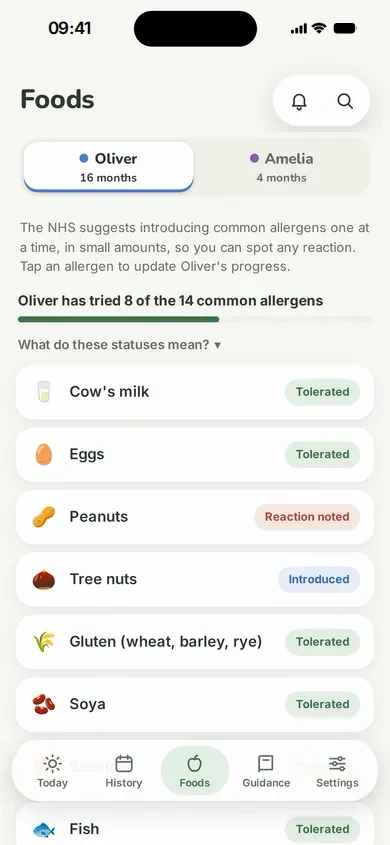
The 14 allergens Tiny Tummies tracks
| In the app | Food law wording |
|---|---|
| Cow's milk | Milk |
| Eggs | Eggs |
| Peanuts | Peanuts |
| Tree nuts | Nuts such as almonds, hazelnuts, walnuts, and cashews |
| Gluten | Cereals containing gluten, such as wheat, barley, rye, and oats |
| Soya | Soybeans |
| Sesame | Sesame |
| Fish | Fish |
| Crustaceans | Prawns, crab, and lobster |
| Molluscs | Mussels, oysters, and squid |
| Mustard | Mustard |
| Celery | Celery |
| Lupin | Lupin |
| Sulphites | Sulphur dioxide and sulphites |
The list comes from UK food law, as set out by the Food Standards Agency. See Food allergy and intolerance.
What if my baby has a reaction?
Follow NHS guidance
Tiny Tummies is a record, not a diagnosis. If you see signs of a food allergy, follow the NHS guidance on food allergies in babies and young children.
The NHS says a severe allergic reaction (anaphylaxis) can be life-threatening, and to call 999 and get medical help immediately. See the NHS page on anaphylaxis.
Afterwards, mark the allergen as Reaction noted so you have a record to refer to when you speak to your GP or health visitor.
Allergen tracker questions
Does the NHS say there are 14 allergens?
The 14 come from UK food law, not from the NHS page on introducing foods. The Food Standards Agency explains the 14 regulated allergens: Food allergy and intolerance. The NHS page explains how to introduce foods that can trigger allergy, and it lists them in its own words, so the two lists do not match word for word.
Does Tiny Tummies diagnose allergies?
No. It is a record of what you introduced and what happened, not a diagnosis. Talk to your GP or health visitor if you have concerns.
Can the scanner fill in allergens?
Yes. Allergens from a scanned or searched product are ticked automatically from its label. Highlighted allergens from a food name are only a suggestion, so tap to confirm. The data is from Open Food Facts and can be incomplete, so always read the packet.
Can I track allergens for more than one child?
Yes. Each child has their own allergen list and their own progress.
Related
Start tracking today
Keep track of every allergen as you introduce it.
Download on the App Store£2.49 once. No subscription, ever.